There's a new acronym floating around marketing right now, and it's making smart business owners feel behind. SEO, you know. Suddenly someone drops "GEO" in a meeting. A vendor emails you about "AEO." Then your competitor posts something on LinkedIn that makes it sound like everything you've done for the last decade is obsolete.
So let's clear it up, because the confusion is costing people money, and because cutting through it happens to be one of the things we do best at Fortress.
Here's the short version: the fundamentals haven't been thrown out. The finish line moved.
And we've had a front-row seat to it. Over the past year, a growing number of our clients and prospects have started asking us about AEO. But here's the real tell: most people still have no idea what it even is. That gap, between the handful of people who are already asking and the many who don't yet know to ask, is exactly where the opportunity lives. And don't worry, you aren't behind (yet).
The Information Age Quietly Became the Answer Age
For twenty years, search worked one way. You typed a question into Google, Google handed you ten blue links, and you clicked one to go find your answer. The whole game, the entire SEO industry, was built on winning those clicks. Rank higher, get more traffic, win. Land on page one. Land at the top of page one. Easy win.
That era is ending in real time.
People increasingly don't want a list of places where the answer might be and then have to dig through those search results to find what serves them best. They want the answer, tailored to their exact situation, and they want it now. And the tools are finally good enough to just give it to them. Ask ChatGPT (which now has north of 900 million weekly users, up from 300 million just over a year ago) and it writes you a paragraph. This shift isn't happening at the margins; it's happening at the center of where everyone already looks. Google still commands roughly 90% of search and fields billions of queries a day. Ask it and, more and more, an AI Overview answers at the top before a single blue link appears. Users want answers, not just information.
The result is what the industry calls "no-click" or "zero-click" search. As of early 2026, roughly 68% of U.S. Google searches end without a click to any website, up from about 60% two years ago. When an AI Overview shows up, click-through rates to the pages below drop by around 60%. Google's AI Mode has crossed a billion monthly users. The answer is the destination now. The website is often just the raw material the answer was built from. This doesn't mean SEO is dead. It means the way users search has fundamentally changed, and it's more important than ever to command their attention in the places they're getting answers.
This is the shift from the Information Age, where Google indexed the world's information and pointed you toward it, to the Answer Age, where machines read that information and hand you the conclusion directly, tailored to you.
That's not a threat to businesses that adapt. It's the biggest opportunity in search since Google itself.
OK, So What Do SEO, GEO, and AEO Actually Mean?
Plain-English definitions, no marketing jargon:
SEO: Search Engine Optimization. The classic. Making your website rank in traditional search results so people click through to you. Still alive, still matters, but it's no longer the whole board.
GEO: Generative Engine Optimization. A very close cousin to AEO. GEO specifically targets generative AI engines, the ones that write original responses like ChatGPT, Gemini, and Perplexity. In practice, most people use AEO and GEO to mean nearly the same thing: show up in AI-generated answers. Don't lose sleep over the distinction. If someone insists there's a life-or-death difference between the two, that's usually a sign they're selling confusion.
AEO: Answer Engine Optimization. Getting your business to be the answer, inside ChatGPT, Google's AI Overviews, Claude, Perplexity, and every other tool that responds with a direct answer instead of a list of links. The goal shifts from "rank #1" to "be the source the AI cites and recommends."
The through-line: SEO wins clicks, AEO and GEO win the answer itself. In 2026, you want both, but the growth and the attention are moving toward the answer.
The Part Nobody Selling "AI-First Everything" Wants to Admit
Here's the reassuring truth we keep coming back to with clients: the basics of good SEO are still what power AEO.
Whenever a client or prospect asks us how they're going to get into AI search, we always respond that the basic blocking and tackling we've been doing on SEO forms the foundation for AEO. That means the same core disciplines, now pointed at a new target:
- Publishing fresh, genuinely useful content on a consistent schedule
- Building FAQ pages that answer the real questions people ask, in plain language
- Adding structured data and schema so machines can cleanly parse your pages
- Earning credible mentions and citations from sites the models already trust
- Keeping your technical house in order so crawlers can actually read you
The AI models answering these questions were trained on, and actively pull from, the same web that Google crawls. They favor content that is clear, well-structured, genuinely authoritative, and trustworthy, which is exactly what real SEO has always rewarded: clean site architecture, content that actually answers the question, credible sources, strong topical authority, technical hygiene that lets a crawler read your pages. That work didn't get thrown out. It got more valuable, because now it feeds two systems instead of one.
What changes is the emphasis. You optimize for being quotable, not just clickable. You structure content so a machine can lift a clean, correct answer straight out of it. You build authority signals that make an AI comfortable citing you over the other twenty options. But you're building on the same foundation, which is great news if you've done the fundamentals right, and a wake-up call if you haven't.
Anyone telling you AEO means burning your SEO playbook to the ground is lying to you the same way any agency that promised guaranteed first-page results in SEO was for the past twenty years.
What We're Actually Seeing at Fortress
We didn't wait for the acronyms to trend. We've been doing this work for our clients for over a year, while fully integrating AI into our agency, and the results are real.
One example from a recent Fortress campaign: we got a personal injury lawyer to show up as not just the first result in ChatGPT, but the only firm shown on the map, complete with their picture, in the AI search results. This is the result of having the right website structure, generating the right content, and a range of other activities that helped position them as the authority in a key market they were targeting.
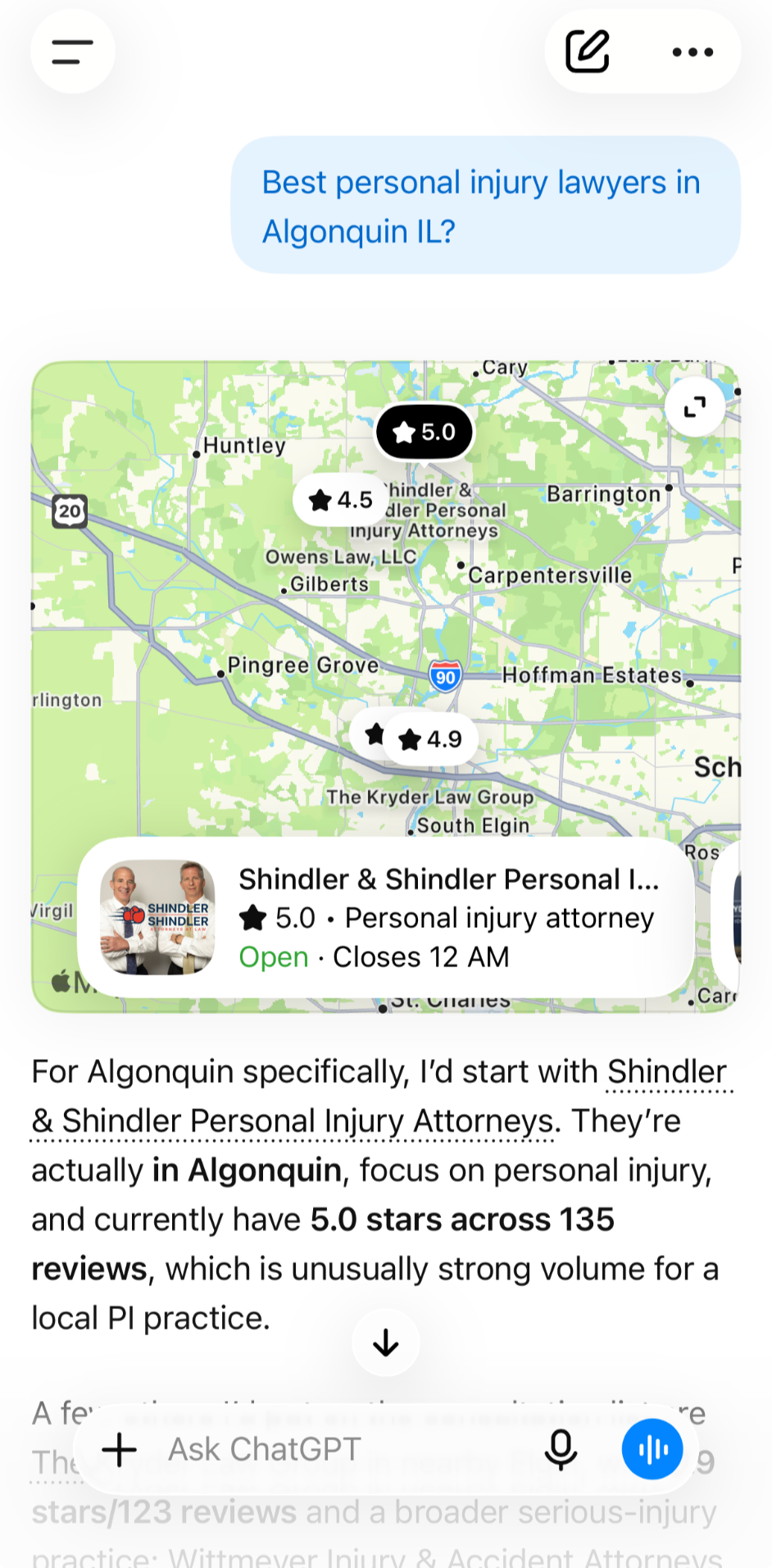
The pattern we see over and over: getting named inside an AI answer isn't luck, and it isn't a black box. It comes down to discipline and consistency. And it's one we've gotten good at.
What's Next: You'll Be Able to Buy Your Way Into the Answer Too
Here's where it gets even more interesting. Earlier this year, OpenAI began rolling out ads inside ChatGPT: clearly labeled, contextually matched to the conversation, and already live across the U.S. and a growing list of countries. Answer engines are becoming ad platforms, just like search did.
That means the Answer Age will have both an earned side and a paid side, exactly like SEO and paid search have coexisted for years. Earn your way into the answer through great AEO, and increasingly, pay to be there too.
We're already moving on it. Paid ads on ChatGPT are the next thing we're building out for clients, so you can win the answer on both fronts: the organic recommendation and the sponsored placement right next to it.
Chances are you haven't even seen ads inside ChatGPT yet. But you will.
Don't Take Our Word for It. Go Ask the Machine.
Here's a live experiment you can run in the next thirty seconds. Open ChatGPT and search this:
"Chicago agency for branding, corporate identity, website design and development, and performance marketing."
There's a very good chance you'll see Fortress sitting right near the top.
That isn't luck, and it isn't us gaming anything. It's AEO working exactly the way it's supposed to. We've published clear, structured, authoritative content that claims that language, so when someone asks for it, the answer engines are confident the answer is us. The words a prospect types and the words on our site line up, and the machine connects the dots.
Now try a harder one. Ask for the "best answer engine optimization agency," and today you'll get a list of other names. We know, because we check ours constantly. Closing that exact gap, claiming the high-value language your customers use before your competitors do, is the entire discipline of AEO. It's the work we do for our clients every day, and the work we're doing for Fortress in public, including on the very page you're reading right now.
So here's the real question worth sitting with: when your best prospect asks an AI engine for exactly what you sell, whose name comes back?
The Bottom Line
SEO isn't dead. It grew up. The Information Age has handed the baton to the Answer Age. Now, the businesses seen as the authorities, the ones giving the answers in ChatGPT, in Google's AI Overviews, in Claude, everywhere people go for a direct response, are the ones that will win the next decade of search.
The good news is you don't have to start over. The fundamentals still work. You just need someone who understands where the finish line moved.
That's the whole game now. And we've got the answer to your questions.